Back to Articles
How to Write an AV Proposal That Wins More Jobs | AV Integrator Guide
If you're an AV integrator, your proposal is not just a document — it's your sales tool, your brand, and your competitive edge.
Yet most AV proposals fall into one of two traps:
Too technical and overwhelming
Too basic and lacking confidence
The result? Lost jobs, slower sales cycles, and price-driven decisions.
In this guide, we’ll break down exactly how to write an AV proposal that:
Converts more clients
Positions you as the expert
Wins against competitors (even if you're not the cheapest)
Why AV Proposals Matter More Than You Think
Most integrators assume clients buy based on:
Price
Equipment
Brand names
In reality, clients buy based on confidence and clarity.
Your proposal answers one critical question:
“Do I trust this company to deliver this project?”
A strong proposal:
Reduces back-and-forth questions
Speeds up approvals
Justifies higher margins
Differentiates you from competitors
1. Start With a Clear Project Overview
Before listing products, explain:
What the system does
How it improves the client’s lifestyle or business
Why it has been designed this way
Example:
Instead of:
“Supply and install 5.1 surround sound system”
Write:
“This system delivers immersive cinema-quality audio throughout your media room, designed to provide clarity at low volumes and impact at higher levels, without compromising aesthetics.”
👉 This is called “selling the outcome, not the equipment.”
2. Structure Your Proposal Like a Story
A winning AV proposal should flow logically:
Introduction
Project overview
System design (by room or function)
Product breakdown
Pricing summary
Optional upgrades
Terms & acceptance
This structure:
Makes it easy to read
Reduces overwhelm
Guides the client to a decision
3. Break Systems Down (Don’t Dump a Product List)
One of the biggest mistakes:
Sending a long, flat list of products.
Instead, group items into systems or areas:
Living Room Entertainment
Whole-Home Audio
Lighting Control
Security
This helps the client:
Understand value
See how everything connects
Justify the cost
4. Use Visuals to Increase Conversion
Clients don’t understand part numbers — they understand visuals.
Include:
Product images
Room breakdowns
Floor plans (if possible)
System diagrams
This dramatically improves:
Engagement
Perceived professionalism
Conversion rate
5. Offer Options (But Control the Decision)
High-performing proposals don’t give one price — they give structured, configurable choices.
Example:
Good → Better → Best
Add-ons (e.g. upgraded speakers, additional zones)
This:
Anchors pricing
Prevents “too expensive” objections
Increases average order value
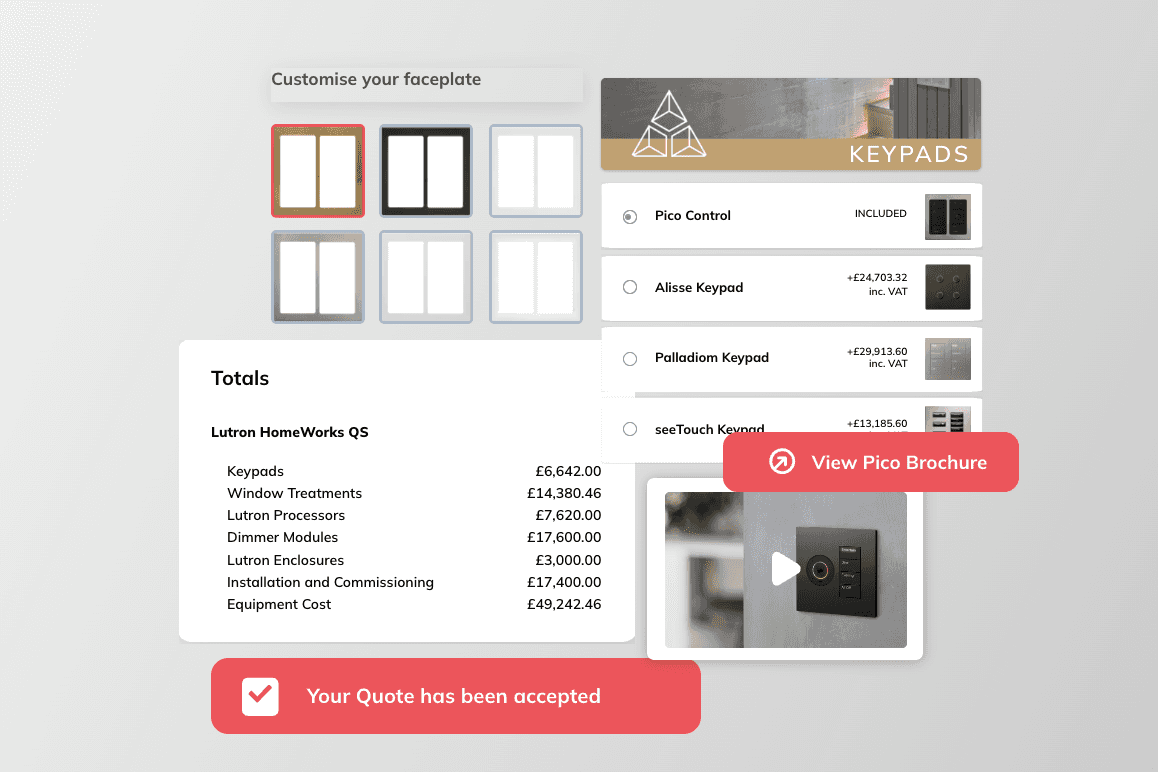
Take It Further: Let the Client Configure the Proposal
The most advanced AV proposals now go beyond static options.
Instead of sending a fixed document, leading integrators allow clients to:
Toggle options on/off
Upgrade systems themselves
See pricing update live
This creates a buying experience, not just a quote.
Why this matters:
Keeps the client engaged for longer
Reduces the need for revisions
Gives the client a sense of control
Prevents them from going elsewhere to “compare” — because they’re already exploring options within your proposal
Instead of leaving your proposal to look at competitors, they stay inside your ecosystem adjusting their system in real-time.
6. Keep Pricing Clear and Confident
Avoid:
Overly complex pricing breakdowns
Hidden costs
Confusing terminology
Instead:
Use clear totals per system
Show optional upgrades separately
Reinforce value, not just cost
7. Remove Friction From Approval
The easier it is to say yes, the more deals you win.
Best practices:
Digital acceptance (not printed PDFs)
Clear acceptance button or signature
Simple next steps
Advanced Tip: Protect Your Proposal From Competitors
One of the biggest hidden risks in AV sales:
Your proposal gets forwarded to competitors for undercutting.
Once a client has your full system design and pricing, it becomes easy for others to:
Copy your work
Undercut your price
Win the job
How Smart Integrators Handle This
Modern proposal tools now allow you to:
Track when a client has viewed your proposal
See engagement and timing
Take action based on buyer intent
More importantly:
You can disable access to the proposal link after it has been viewed.
This means:
The client can review everything properly
But the link cannot be endlessly shared or forwarded
Your design and pricing stay protected
From a sales perspective, this is extremely powerful:
You know exactly when to follow up
You create urgency
You reduce the chance of being used as a “shopping list” for competitors
Why This Matters More Than Ever
In today’s AV market:
Clients are more informed
Competition is higher
Price comparison is easier than ever
The integrators winning the most work are not just:
Faster
Cheaper
More technical
They are the ones who:
Control the buying experience
Keep the client engaged inside their proposal
Protect their work from being reused elsewhere
Why WeQuote Helps You Win More Jobs
WeQuote is built specifically for AV integrators and solves the core problems above:
Live supplier pricing → No outdated quotes
System-based structure → Clear, client-friendly proposals
Interactive options tool → Clients can configure systems with live pricing
Proposal tracking + link control → Know when it’s viewed and disable access if needed
Faster quoting → More quotes sent, more jobs won
Most importantly:
It helps you keep the client inside your proposal — and away from your competitors.
8. Follow Up the Right Way
Most deals are lost due to:
Poor or inconsistent follow-up.
A strong process:
Day 1: Send proposal
Day 2–3: Check-in call
Day 5–7: Value-based follow-up
Day 10+: Final nudge
The Hidden Problem With Most AV Proposals
Even if you follow all of the above…
Most integrators still struggle because:
Proposals take too long to build
Pricing is outdated or manual
Documents look inconsistent
There’s no standardisation across the team
This leads to:
Slower turnaround
Lower conversion rates
Lost revenue
How Leading Integrators Solve This
Top AV companies don’t build proposals manually.
Pull live pricing from suppliers
Structure systems automatically
Generate branded proposals instantly
Allow clients to interact and approve digitally
This is where tools like WeQuote come in.
Why WeQuote Helps You Win More Jobs
WeQuote is built specifically for AV integrators and solves the core problems above:
Live supplier pricing → No outdated quotes
System-based structure → Clear, client-friendly proposals
Interactive proposals → Better engagement and approvals
Faster quoting → More quotes sent, more jobs won
Most importantly:
It helps you present your work in a way that puts your client in a position to buy.
Final Thoughts
Winning more AV projects isn’t about:
Lowering your price
Working harder
Sending more quotes
It’s about sending better proposals.
If your proposal:
Builds confidence
Explains value
Makes decisions easy
You’ll naturally win more work.
FAQs
What should be included in an AV proposal?
An AV proposal should include a project overview, system design, product breakdown, pricing, optional upgrades, and clear acceptance terms.
How do you make an AV proposal stand out?
Focus on clarity, visuals, structured systems, and outcome-based descriptions rather than technical product lists.
What software do AV integrators use for proposals?
Many integrators use specialised platforms like WeQuote, D-Tools, or other AV quoting software to streamline the process and improve conversion rates.
How long should an AV proposal be?
Long enough to explain the system clearly, but structured so it’s easy to scan. Clarity is more important than length.
If you're an AV integrator, your proposal is not just a document — it's your sales tool, your brand, and your competitive edge.
Yet most AV proposals fall into one of two traps:
Too technical and overwhelming
Too basic and lacking confidence
The result? Lost jobs, slower sales cycles, and price-driven decisions.
In this guide, we’ll break down exactly how to write an AV proposal that:
Converts more clients
Positions you as the expert
Wins against competitors (even if you're not the cheapest)
Why AV Proposals Matter More Than You Think
Most integrators assume clients buy based on:
Price
Equipment
Brand names
In reality, clients buy based on confidence and clarity.
Your proposal answers one critical question:
“Do I trust this company to deliver this project?”
A strong proposal:
Reduces back-and-forth questions
Speeds up approvals
Justifies higher margins
Differentiates you from competitors
1. Start With a Clear Project Overview
Before listing products, explain:
What the system does
How it improves the client’s lifestyle or business
Why it has been designed this way
Example:
Instead of:
“Supply and install 5.1 surround sound system”
Write:
“This system delivers immersive cinema-quality audio throughout your media room, designed to provide clarity at low volumes and impact at higher levels, without compromising aesthetics.”
👉 This is called “selling the outcome, not the equipment.”
2. Structure Your Proposal Like a Story
A winning AV proposal should flow logically:
Introduction
Project overview
System design (by room or function)
Product breakdown
Pricing summary
Optional upgrades
Terms & acceptance
This structure:
Makes it easy to read
Reduces overwhelm
Guides the client to a decision
3. Break Systems Down (Don’t Dump a Product List)
One of the biggest mistakes:
Sending a long, flat list of products.
Instead, group items into systems or areas:
Living Room Entertainment
Whole-Home Audio
Lighting Control
Security
This helps the client:
Understand value
See how everything connects
Justify the cost
4. Use Visuals to Increase Conversion
Clients don’t understand part numbers — they understand visuals.
Include:
Product images
Room breakdowns
Floor plans (if possible)
System diagrams
This dramatically improves:
Engagement
Perceived professionalism
Conversion rate
5. Offer Options (But Control the Decision)
High-performing proposals don’t give one price — they give structured, configurable choices.
Example:
Good → Better → Best
Add-ons (e.g. upgraded speakers, additional zones)
This:
Anchors pricing
Prevents “too expensive” objections
Increases average order value
Take It Further: Let the Client Configure the Proposal
The most advanced AV proposals now go beyond static options.
Instead of sending a fixed document, leading integrators allow clients to:
Toggle options on/off
Upgrade systems themselves
See pricing update live
This creates a buying experience, not just a quote.
Why this matters:
Keeps the client engaged for longer
Reduces the need for revisions
Gives the client a sense of control
Prevents them from going elsewhere to “compare” — because they’re already exploring options within your proposal
Instead of leaving your proposal to look at competitors, they stay inside your ecosystem adjusting their system in real-time.
6. Keep Pricing Clear and Confident
Avoid:
Overly complex pricing breakdowns
Hidden costs
Confusing terminology
Instead:
Use clear totals per system
Show optional upgrades separately
Reinforce value, not just cost
7. Remove Friction From Approval
The easier it is to say yes, the more deals you win.
Best practices:
Digital acceptance (not printed PDFs)
Clear acceptance button or signature
Simple next steps
Advanced Tip: Protect Your Proposal From Competitors
One of the biggest hidden risks in AV sales:
Your proposal gets forwarded to competitors for undercutting.
Once a client has your full system design and pricing, it becomes easy for others to:
Copy your work
Undercut your price
Win the job
How Smart Integrators Handle This
Modern proposal tools now allow you to:
Track when a client has viewed your proposal
See engagement and timing
Take action based on buyer intent
More importantly:
You can disable access to the proposal link after it has been viewed.
This means:
The client can review everything properly
But the link cannot be endlessly shared or forwarded
Your design and pricing stay protected
From a sales perspective, this is extremely powerful:
You know exactly when to follow up
You create urgency
You reduce the chance of being used as a “shopping list” for competitors
Why This Matters More Than Ever
In today’s AV market:
Clients are more informed
Competition is higher
Price comparison is easier than ever
The integrators winning the most work are not just:
Faster
Cheaper
More technical
They are the ones who:
Control the buying experience
Keep the client engaged inside their proposal
Protect their work from being reused elsewhere
Why WeQuote Helps You Win More Jobs
WeQuote is built specifically for AV integrators and solves the core problems above:
Live supplier pricing → No outdated quotes
System-based structure → Clear, client-friendly proposals
Interactive options tool → Clients can configure systems with live pricing
Proposal tracking + link control → Know when it’s viewed and disable access if needed
Faster quoting → More quotes sent, more jobs won
Most importantly:
It helps you keep the client inside your proposal — and away from your competitors.
8. Follow Up the Right Way
Most deals are lost due to:
Poor or inconsistent follow-up.
A strong process:
Day 1: Send proposal
Day 2–3: Check-in call
Day 5–7: Value-based follow-up
Day 10+: Final nudge
The Hidden Problem With Most AV Proposals
Even if you follow all of the above…
Most integrators still struggle because:
Proposals take too long to build
Pricing is outdated or manual
Documents look inconsistent
There’s no standardisation across the team
This leads to:
Slower turnaround
Lower conversion rates
Lost revenue
How Leading Integrators Solve This
Top AV companies don’t build proposals manually.
Pull live pricing from suppliers
Structure systems automatically
Generate branded proposals instantly
Allow clients to interact and approve digitally
This is where tools like WeQuote come in.
Why WeQuote Helps You Win More Jobs
WeQuote is built specifically for AV integrators and solves the core problems above:
Live supplier pricing → No outdated quotes
System-based structure → Clear, client-friendly proposals
Interactive proposals → Better engagement and approvals
Faster quoting → More quotes sent, more jobs won
Most importantly:
It helps you present your work in a way that puts your client in a position to buy.
Final Thoughts
Winning more AV projects isn’t about:
Lowering your price
Working harder
Sending more quotes
It’s about sending better proposals.
If your proposal:
Builds confidence
Explains value
Makes decisions easy
You’ll naturally win more work.
FAQs
What should be included in an AV proposal?
An AV proposal should include a project overview, system design, product breakdown, pricing, optional upgrades, and clear acceptance terms.
How do you make an AV proposal stand out?
Focus on clarity, visuals, structured systems, and outcome-based descriptions rather than technical product lists.
What software do AV integrators use for proposals?
Many integrators use specialised platforms like WeQuote, D-Tools, or other AV quoting software to streamline the process and improve conversion rates.
How long should an AV proposal be?
Long enough to explain the system clearly, but structured so it’s easy to scan. Clarity is more important than length.
Back to Articles
© 2025 Ouitech Ltd All rights reserved.
Company number 12576882 | VAT number 374037596
Start a 14 Day Free Trial on any of our paid plans.
Try WEQUOTE for Free
© 2025 Ouitech Ltd All rights reserved.
Company number 12576882 | VAT number 374037596
Start a 14 Day Free Trial on any of our paid plans.
Try WEQUOTE for Free
Try WEQUOTE
for Free
Start a 14 Day Free Trial on any of our paid plans.
© 2025 Ouitech Ltd. All rights reserved.
Company number 12576882 | VAT number 374037596
Features
Integrations
Manufacturers
& Distributors
Platform
Resources