Back to Articles
AV Quoting Software: A Complete Guide for AV Integrators in 2026
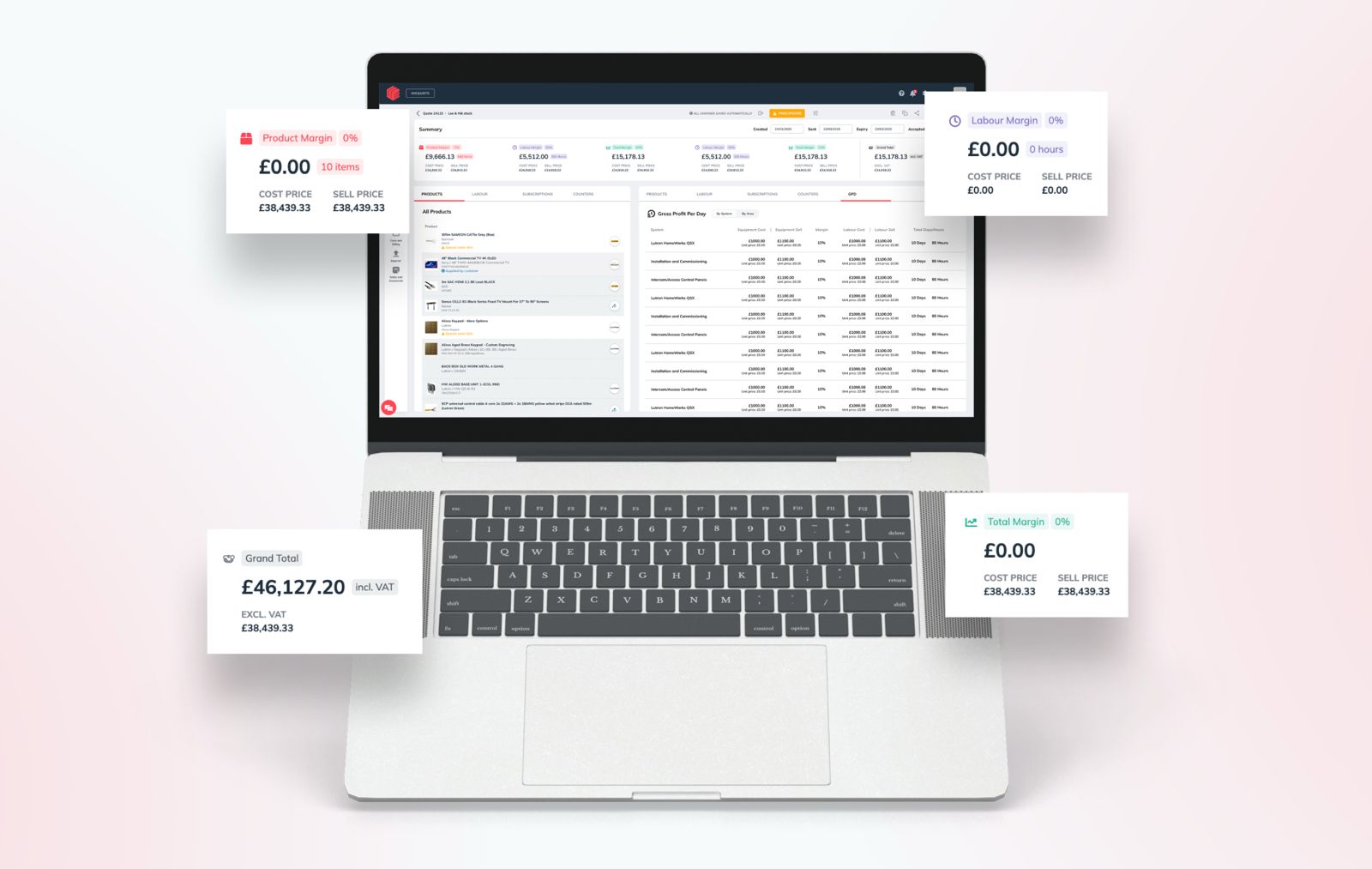
If you run an AV integration business, quoting is probably taking more of your time than it should.
Between pulling pricing from supplier portals, building out system configurations, formatting a presentable proposal, and chasing approvals — a single residential quote can easily consume half a day. For a business quoting ten jobs a week, that adds up to a significant chunk of every working week spent on administration rather than installation.
This guide covers everything AV integrators need to know about quoting software in 2026: what it actually does, what separates a purpose-built AV platform from a generic tool, what to look for when evaluating your options, and how the right choice affects your business beyond just saving time.
Whether you are currently quoting on spreadsheets, using a generic proposal tool, or considering a switch from your existing platform, this guide gives you a clear framework for making the right call.
What Is AV Quoting Software?
AV quoting software is a platform built specifically to help audio visual integration businesses create, price, and deliver project proposals to clients.
At its most basic, it replaces the spreadsheet. But purpose-built platforms go considerably further than that — they connect to live supplier catalogues, understand how AV systems are structured, generate professional client-facing proposals, and link the approved quote to procurement, project management, and invoicing in a single workflow.
The key word is ‘purpose-built’. Generic quoting tools like PandaDoc or Proposify produce professional-looking documents, but they have no understanding of AV — they cannot pull live manufacturer pricing, they do not know that a touchpanel and a processor are part of the same system, and they offer no path from a signed quote to a purchase order. The gap between a generic quoting tool and an AV-specific platform is significant in practice, and it widens as your business scales.
Why Quoting Is Uniquely Challenging in AV Integration
Compared to many other trades, AV quoting has several characteristics that make it genuinely difficult to do well with off-the-shelf tools.
Product complexity
An AV system is not a list of independent items — it is a set of components with defined relationships. A Crestron home automation system requires a specific processor, a compatible touchpanel, the relevant software licence, and often a cloud services subscription. Quote one element without the others and the system does not work. Generic tools have no concept of this; AV-specific platforms do.
Pricing volatility
Supplier pricing changes regularly. Crestron, Lutron, and the major distributors update their price lists periodically, and the gap between a list price and what you actually pay can vary by account tier. An integrator manually maintaining a pricing spreadsheet is always working with data that is partially out of date — which means either undercharging when prices go up or spending time on manual updates that could be automated.
Proposal presentation matters
In residential AV particularly, the quality of your proposal directly affects whether you win the job. A homeowner who is also talking to a smart home installer, an electrician, and a custom furniture maker is comparing proposals visually as much as functionally. A well-presented, branded, interactive proposal communicates professionalism and attention to detail — the same qualities your client wants from the installation itself.
The workflow does not stop at the quote
Once a quote is approved, the work is not over — it has just started. The line items in that quote need to become purchase orders, warehouse intake records, technician schedules, and eventually invoices. Every time that data is re-entered from one system to another, there is a risk of error and a cost in time. A platform that handles the full workflow eliminates that problem entirely.
What to Look for in AV Quoting Software
Not all AV quoting platforms are equal. When evaluating your options, these are the capabilities that make a material difference to how the software performs in practice.
1. Live supplier catalogue integration
The ability to pull real-time pricing directly from distributors like Midwich, ADI, and manufacturers like Crestron and Lutron is the single most impactful feature in terms of time saved. It eliminates manual price lookups, ensures your quotes reflect current pricing, and removes the margin risk of working from a stale spreadsheet.
2. System-based product relationships
A good AV quoting platform understands that products belong to systems. It will flag missing components, suggest related items, and allow you to build reusable system templates that can be dropped into new quotes in seconds. This is the feature that most dramatically reduces the time it takes to quote a standard project type.
3. Professional proposal output
The client-facing proposal should be something you are proud to send. Look for branded templates, clear system descriptions written for a non-technical audience, an itemised pricing breakdown, and ideally a digital approval mechanism that allows clients to accept and sign without printing anything.
4. End-to-end workflow
The best platforms do not stop at the approved quote. They connect directly to procurement — generating purchase orders from the accepted quote — and then to project scheduling, inventory management, and invoicing. The less data you re-enter between systems, the less time you spend on administration and the fewer errors you make.
5. Speed
This sounds obvious, but it is worth stating explicitly: the fastest route between a client site visit and a submitted proposal is a competitive advantage. If your quoting software requires more than a couple of hours to produce a standard residential quote, it is slowing you down relative to competitors using better tools.
How the Right Quoting Software Changes Your Business
The impact of switching to a purpose-built AV quoting platform tends to show up in a few specific places.
More quotes, in less time
The most immediate effect is speed. Integrators who move from spreadsheet-based quoting to a platform with live pricing and system templates typically report producing the same standard quote in a fraction of the time. That either means more quotes submitted per week — increasing the volume of jobs you can pursue — or more time available for everything else.
Fewer pricing errors
Manual pricing processes create errors. They tend to go one way — underpricing — because list price increases are not always caught immediately and scope gaps are not flagged automatically. Live catalogue pricing and system-based templates both reduce this risk substantially.
Better win rates
There is consistent evidence across professional services that proposal quality affects win rates. WeQuote found that proposals with a consistent structure and professional presentation close at significantly higher rates than unformatted alternatives. In AV, where the client is often making a large investment in a system they do not fully understand technically, a clear and professional proposal builds the confidence that drives a decision.
A cleaner handoff from sales to delivery
When the same platform handles the quote and the subsequent procurement and project workflow, the information the sales team collects during quoting flows directly to the installation team. There is no re-entry of product lists, no translating a quote into a purchase order manually, and no risk of the field team working from different specifications to the signed proposal.
The businesses gaining the most from modern quoting software are not necessarily the largest — they are the ones that have eliminated the gap between quoting speed and installation quality. Those two things used to be in tension. The right software removes the tension.
The Real Cost of Poor Quoting Infrastructure
Most AV businesses underestimate what inefficient quoting costs them, because the costs are distributed and invisible rather than appearing on a single line of a P&L.
Lost deals from slow response
In the residential market particularly, the time between a site visit and a submitted proposal matters. A client who has spoken to three integrators and received two proposals within 24 hours and one in four days has already formed a view about which business is most organised. Quoting speed is a proxy for operational competence.
Margin erosion from manual pricing
An integrator maintaining prices manually in a spreadsheet is working with a snapshot that gets less accurate over time. Price increases from suppliers that are not immediately reflected in quoting templates result in systematically underpriced jobs. Over a year of quoting, this represents real lost margin.
Scope gaps
Generic and spreadsheet-based tools have no knowledge of what a complete system requires. A Crestron installation quoted without the required licence, or a multi-room audio system missing amplifier channels, means either absorbing an unexpected cost after the job is won or a difficult conversation with a client. System-based quoting tools flag these gaps before the quote leaves the building.
A single missed manufacturer software licence on a mid-size residential project typically represents £1,500–£3,000 of unrecovered cost. One scope gap per month is the difference between a profitable and a marginal year.
Which AV Businesses Need Specialist Quoting Software?
The honest answer is: most of them. But the urgency varies depending on where your business is.
You need it now if: you are quoting more than five or six projects a month and still using spreadsheets. At that volume, the time cost of manual quoting and the risk of pricing errors is significant enough to affect your profitability directly.
You probably need it if: you are using a generic proposal tool and finding yourself spending time on manual pricing updates, formatting work, or re-entering data between your quote and your purchasing process.
You should at least evaluate it if: you are on an existing AV-specific platform but feel like quoting is still slower than it should be, or you are running separate systems for quoting, procurement, and project management that require manual handoffs between them.
The businesses for whom specialist quoting software genuinely makes no sense are those doing only a handful of projects a year where the overhead of any platform is not worth it. For anyone running a business with consistent project volume and growth ambitions, the ROI calculation is straightforward.
➡ Explore the features of an all in one AV Quotation Platform
Where AV Quoting Software Is Heading in 2026
The category is developing quickly. The developments worth paying attention to over the next 12–24 months include:
AI-assisted specification: the ability to suggest system configurations, missing components, and alternative products based on project type, room dimensions, and client brief. Already in early development at several platforms.
Interactive client proposals: proposals that allow clients to add or remove options and see the total update in real time, reducing the back-and-forth of quote revisions.
Real-time margin visibility: live margin tracking as a quote is built, rather than calculating it afterwards. Particularly valuable for businesses managing large volumes of projects simultaneously.
Deeper procurement integration: tighter connections between the approved quote and distributor ordering systems, reducing the steps between a signed proposal and items being ordered.
The direction is towards platforms where the distance between ‘client brief’ and ‘purchase order raised’ keeps shrinking. Businesses that adopt modern platforms now will be better positioned to benefit from these developments as they arrive.
About WeQuote
WeQuote is an AV quoting and business management platform built specifically for AV integration companies. It covers quoting, procurement, inventory, project management, technician scheduling, and invoicing in a single platform, with live pricing from over 400 supplier catalogues including Crestron, Lutron, Midwich, and ADI.
It was built by people who understand how AV businesses actually operate — not adapted from a generic tool.
➡ Start a free 14-day trial — no credit card, no commitment
➡ Book a 30-minute demo — see it with your own project type
Frequently Asked Questions
What does AV quoting software actually do?
At a minimum, it creates structured, professional proposals for AV installation projects. Purpose-built platforms also connect to live supplier pricing, handle system-based product relationships, generate purchase orders from approved quotes, and manage the full project workflow through to invoicing.
Is AV quoting software suitable for small integration businesses?
Yes — the time saving is proportionally just as valuable for a small business as a large one. The key threshold is project volume: businesses quoting five or more projects a month typically see a strong return from switching to a dedicated platform.
Can I use a generic quoting tool like PandaDoc for AV projects?
You can, but you will lose the capabilities that make the biggest practical difference: live supplier pricing, system-based product logic, and the ability to connect the approved quote directly to procurement. Generic tools are a reasonable starting point for very low project volumes, but they create increasing overhead as your business grows.
How long does it take to get set up on a new quoting platform?
With a modern platform like WeQuote, most integrators are producing their first real quote within the first day of their trial. A full migration — importing supplier catalogues, building system templates, and connecting accounting integrations — typically takes one to two weeks.
Does quoting software integrate with accounting tools?
The best platforms integrate directly with Xero and QuickBooks, automatically creating invoices and syncing payments without manual re-entry. This is one of the more significant time savers for businesses processing consistent project volumes.
If you run an AV integration business, quoting is probably taking more of your time than it should.
Between pulling pricing from supplier portals, building out system configurations, formatting a presentable proposal, and chasing approvals — a single residential quote can easily consume half a day. For a business quoting ten jobs a week, that adds up to a significant chunk of every working week spent on administration rather than installation.
This guide covers everything AV integrators need to know about quoting software in 2026: what it actually does, what separates a purpose-built AV platform from a generic tool, what to look for when evaluating your options, and how the right choice affects your business beyond just saving time.
Whether you are currently quoting on spreadsheets, using a generic proposal tool, or considering a switch from your existing platform, this guide gives you a clear framework for making the right call.
What Is AV Quoting Software?
AV quoting software is a platform built specifically to help audio visual integration businesses create, price, and deliver project proposals to clients.
At its most basic, it replaces the spreadsheet. But purpose-built platforms go considerably further than that — they connect to live supplier catalogues, understand how AV systems are structured, generate professional client-facing proposals, and link the approved quote to procurement, project management, and invoicing in a single workflow.
The key word is ‘purpose-built’. Generic quoting tools like PandaDoc or Proposify produce professional-looking documents, but they have no understanding of AV — they cannot pull live manufacturer pricing, they do not know that a touchpanel and a processor are part of the same system, and they offer no path from a signed quote to a purchase order. The gap between a generic quoting tool and an AV-specific platform is significant in practice, and it widens as your business scales.
Why Quoting Is Uniquely Challenging in AV Integration
Compared to many other trades, AV quoting has several characteristics that make it genuinely difficult to do well with off-the-shelf tools.
Product complexity
An AV system is not a list of independent items — it is a set of components with defined relationships. A Crestron home automation system requires a specific processor, a compatible touchpanel, the relevant software licence, and often a cloud services subscription. Quote one element without the others and the system does not work. Generic tools have no concept of this; AV-specific platforms do.
Pricing volatility
Supplier pricing changes regularly. Crestron, Lutron, and the major distributors update their price lists periodically, and the gap between a list price and what you actually pay can vary by account tier. An integrator manually maintaining a pricing spreadsheet is always working with data that is partially out of date — which means either undercharging when prices go up or spending time on manual updates that could be automated.
Proposal presentation matters
In residential AV particularly, the quality of your proposal directly affects whether you win the job. A homeowner who is also talking to a smart home installer, an electrician, and a custom furniture maker is comparing proposals visually as much as functionally. A well-presented, branded, interactive proposal communicates professionalism and attention to detail — the same qualities your client wants from the installation itself.
The workflow does not stop at the quote
Once a quote is approved, the work is not over — it has just started. The line items in that quote need to become purchase orders, warehouse intake records, technician schedules, and eventually invoices. Every time that data is re-entered from one system to another, there is a risk of error and a cost in time. A platform that handles the full workflow eliminates that problem entirely.
What to Look for in AV Quoting Software
Not all AV quoting platforms are equal. When evaluating your options, these are the capabilities that make a material difference to how the software performs in practice.
1. Live supplier catalogue integration
The ability to pull real-time pricing directly from distributors like Midwich, ADI, and manufacturers like Crestron and Lutron is the single most impactful feature in terms of time saved. It eliminates manual price lookups, ensures your quotes reflect current pricing, and removes the margin risk of working from a stale spreadsheet.
2. System-based product relationships
A good AV quoting platform understands that products belong to systems. It will flag missing components, suggest related items, and allow you to build reusable system templates that can be dropped into new quotes in seconds. This is the feature that most dramatically reduces the time it takes to quote a standard project type.
3. Professional proposal output
The client-facing proposal should be something you are proud to send. Look for branded templates, clear system descriptions written for a non-technical audience, an itemised pricing breakdown, and ideally a digital approval mechanism that allows clients to accept and sign without printing anything.
4. End-to-end workflow
The best platforms do not stop at the approved quote. They connect directly to procurement — generating purchase orders from the accepted quote — and then to project scheduling, inventory management, and invoicing. The less data you re-enter between systems, the less time you spend on administration and the fewer errors you make.
5. Speed
This sounds obvious, but it is worth stating explicitly: the fastest route between a client site visit and a submitted proposal is a competitive advantage. If your quoting software requires more than a couple of hours to produce a standard residential quote, it is slowing you down relative to competitors using better tools.
How the Right Quoting Software Changes Your Business
The impact of switching to a purpose-built AV quoting platform tends to show up in a few specific places.
More quotes, in less time
The most immediate effect is speed. Integrators who move from spreadsheet-based quoting to a platform with live pricing and system templates typically report producing the same standard quote in a fraction of the time. That either means more quotes submitted per week — increasing the volume of jobs you can pursue — or more time available for everything else.
Fewer pricing errors
Manual pricing processes create errors. They tend to go one way — underpricing — because list price increases are not always caught immediately and scope gaps are not flagged automatically. Live catalogue pricing and system-based templates both reduce this risk substantially.
Better win rates
There is consistent evidence across professional services that proposal quality affects win rates. WeQuote found that proposals with a consistent structure and professional presentation close at significantly higher rates than unformatted alternatives. In AV, where the client is often making a large investment in a system they do not fully understand technically, a clear and professional proposal builds the confidence that drives a decision.
A cleaner handoff from sales to delivery
When the same platform handles the quote and the subsequent procurement and project workflow, the information the sales team collects during quoting flows directly to the installation team. There is no re-entry of product lists, no translating a quote into a purchase order manually, and no risk of the field team working from different specifications to the signed proposal.
The businesses gaining the most from modern quoting software are not necessarily the largest — they are the ones that have eliminated the gap between quoting speed and installation quality. Those two things used to be in tension. The right software removes the tension.
The Real Cost of Poor Quoting Infrastructure
Most AV businesses underestimate what inefficient quoting costs them, because the costs are distributed and invisible rather than appearing on a single line of a P&L.
Lost deals from slow response
In the residential market particularly, the time between a site visit and a submitted proposal matters. A client who has spoken to three integrators and received two proposals within 24 hours and one in four days has already formed a view about which business is most organised. Quoting speed is a proxy for operational competence.
Margin erosion from manual pricing
An integrator maintaining prices manually in a spreadsheet is working with a snapshot that gets less accurate over time. Price increases from suppliers that are not immediately reflected in quoting templates result in systematically underpriced jobs. Over a year of quoting, this represents real lost margin.
Scope gaps
Generic and spreadsheet-based tools have no knowledge of what a complete system requires. A Crestron installation quoted without the required licence, or a multi-room audio system missing amplifier channels, means either absorbing an unexpected cost after the job is won or a difficult conversation with a client. System-based quoting tools flag these gaps before the quote leaves the building.
A single missed manufacturer software licence on a mid-size residential project typically represents £1,500–£3,000 of unrecovered cost. One scope gap per month is the difference between a profitable and a marginal year.
Which AV Businesses Need Specialist Quoting Software?
The honest answer is: most of them. But the urgency varies depending on where your business is.
You need it now if: you are quoting more than five or six projects a month and still using spreadsheets. At that volume, the time cost of manual quoting and the risk of pricing errors is significant enough to affect your profitability directly.
You probably need it if: you are using a generic proposal tool and finding yourself spending time on manual pricing updates, formatting work, or re-entering data between your quote and your purchasing process.
You should at least evaluate it if: you are on an existing AV-specific platform but feel like quoting is still slower than it should be, or you are running separate systems for quoting, procurement, and project management that require manual handoffs between them.
The businesses for whom specialist quoting software genuinely makes no sense are those doing only a handful of projects a year where the overhead of any platform is not worth it. For anyone running a business with consistent project volume and growth ambitions, the ROI calculation is straightforward.
➡ Explore the features of an all in one AV Quotation Platform
Where AV Quoting Software Is Heading in 2026
The category is developing quickly. The developments worth paying attention to over the next 12–24 months include:
AI-assisted specification: the ability to suggest system configurations, missing components, and alternative products based on project type, room dimensions, and client brief. Already in early development at several platforms.
Interactive client proposals: proposals that allow clients to add or remove options and see the total update in real time, reducing the back-and-forth of quote revisions.
Real-time margin visibility: live margin tracking as a quote is built, rather than calculating it afterwards. Particularly valuable for businesses managing large volumes of projects simultaneously.
Deeper procurement integration: tighter connections between the approved quote and distributor ordering systems, reducing the steps between a signed proposal and items being ordered.
The direction is towards platforms where the distance between ‘client brief’ and ‘purchase order raised’ keeps shrinking. Businesses that adopt modern platforms now will be better positioned to benefit from these developments as they arrive.
About WeQuote
WeQuote is an AV quoting and business management platform built specifically for AV integration companies. It covers quoting, procurement, inventory, project management, technician scheduling, and invoicing in a single platform, with live pricing from over 400 supplier catalogues including Crestron, Lutron, Midwich, and ADI.
It was built by people who understand how AV businesses actually operate — not adapted from a generic tool.
➡ Start a free 14-day trial — no credit card, no commitment
➡ Book a 30-minute demo — see it with your own project type
Frequently Asked Questions
What does AV quoting software actually do?
At a minimum, it creates structured, professional proposals for AV installation projects. Purpose-built platforms also connect to live supplier pricing, handle system-based product relationships, generate purchase orders from approved quotes, and manage the full project workflow through to invoicing.
Is AV quoting software suitable for small integration businesses?
Yes — the time saving is proportionally just as valuable for a small business as a large one. The key threshold is project volume: businesses quoting five or more projects a month typically see a strong return from switching to a dedicated platform.
Can I use a generic quoting tool like PandaDoc for AV projects?
You can, but you will lose the capabilities that make the biggest practical difference: live supplier pricing, system-based product logic, and the ability to connect the approved quote directly to procurement. Generic tools are a reasonable starting point for very low project volumes, but they create increasing overhead as your business grows.
How long does it take to get set up on a new quoting platform?
With a modern platform like WeQuote, most integrators are producing their first real quote within the first day of their trial. A full migration — importing supplier catalogues, building system templates, and connecting accounting integrations — typically takes one to two weeks.
Does quoting software integrate with accounting tools?
The best platforms integrate directly with Xero and QuickBooks, automatically creating invoices and syncing payments without manual re-entry. This is one of the more significant time savers for businesses processing consistent project volumes.
Back to Articles
© 2025 Ouitech Ltd All rights reserved.
Company number 12576882 | VAT number 374037596
Start a 14 Day Free Trial on any of our paid plans.
Try WEQUOTE for Free
© 2025 Ouitech Ltd All rights reserved.
Company number 12576882 | VAT number 374037596
Start a 14 Day Free Trial on any of our paid plans.
Try WEQUOTE for Free
Try WEQUOTE
for Free
Start a 14 Day Free Trial on any of our paid plans.
© 2025 Ouitech Ltd. All rights reserved.
Company number 12576882 | VAT number 374037596
Features
Integrations
Manufacturers
& Distributors
Platform
Resources